Tuesday, August 20, 2013

8-6-2013 Arnsburg to Diefurt

After leaving Arnsburg we passed by the Bohming church St John the Baptist.  There were 2 churchs here, the first built in 1189 and it was torn down and this one was built in the later half of the 15th century.  In the field by the church was where another Roman fort was built in the 2nd century.  Across the river are the ruins of a watchtower.

Burg Kipfenberg.  There is a roman museum in the castle which Johanna wanted to see.  It was a steep ride to it but it was worth it.  Lots of info on the limes of the Romans.   Most of the castle is still in private hands is being lived in.

In Kinding we saw a little fortified church along the trail so we went and looked at it.  It all whitewashed and clean but there was nowhere to get a decent pic.  Here is Johanna on the staircase leading to the Organ.

Coming into Beilngries there is the obligatory castle on the hill, Schloss Hirschburg.  We stopped in the town square and had beer but the sun was in the position that pics wouldn't turn out.

In the village we stopped at the St. Vitus church.  It had 15th century fresco in a side chapel.  In the part it shows Adam and Eve on the left.  In the middle a person is being judged and the devil is hanging on the scale at to add a little weight in his favor.  On the right the damned are being led to hell.  It includes a Pope and a bishop.

Another part of the fresco show what I thought was medieval medicine but it turns out to be torture.  On the top a guy is getting his teeth pulled out with a pliers.  On the bottom frame a man is having his intestines rolled up on a spit.

The altar of the St. Vitus church.  Fancy for a little village church.

This is our hotel in Dietfurt.  Rebuilt after the 30 yrs war.  and has been a gestehaus for several hundred years.  Just as we were getting our bags off the bikes 25 women showed up on bikes and were staying there too.  Quite a cluster getting the bikes in the storage.   I didn't think the place had that many rooms.

This is a pic in the room showing the thickness of the walls.  Plus it was a small window.  No breeze and it was warm.  The floor sloped toward the Altmuhl and was just old planks and everything creaked.  Other doors in the hallway were for people under 5 feet.  There was a circular stairway down and it wasn't very high either.  I was always watching not to hit my head on something

8-5-2013 Pappenheim to Arnsburg

We went up to Burg Pappenheim but it was closed.  It dates back to 1140 and is now a museum showing the history of the House of Pappenheim.

At Dietfurt the Altmuhl valley narrows and there are limestone outcroppings.  Here is what is called the 12 apostles, 12 limestone towers along the river.

At Solnhofen the fossil Archaeopteryx was found and one of the first fossils to show the evolution from reptile to birds.  It's a big fossil area.

Bike trail coming into Hagenacker

Trail leading into Dollnstein.  Riding into the village you can see tower built on a rock outcrop.  Around 900 the was a fort with a wooden palisade  here surrounding the outcrop.  By 1100 the wood was replaced with a stone wall.  A little later a castle was built on the outcrop, but has mostly fallen into disrepair.  They had a nice museum inside some of the remaining castle.  In 2007 a bag containing 4000 coins dating from the middle ages was dug up in the castle.

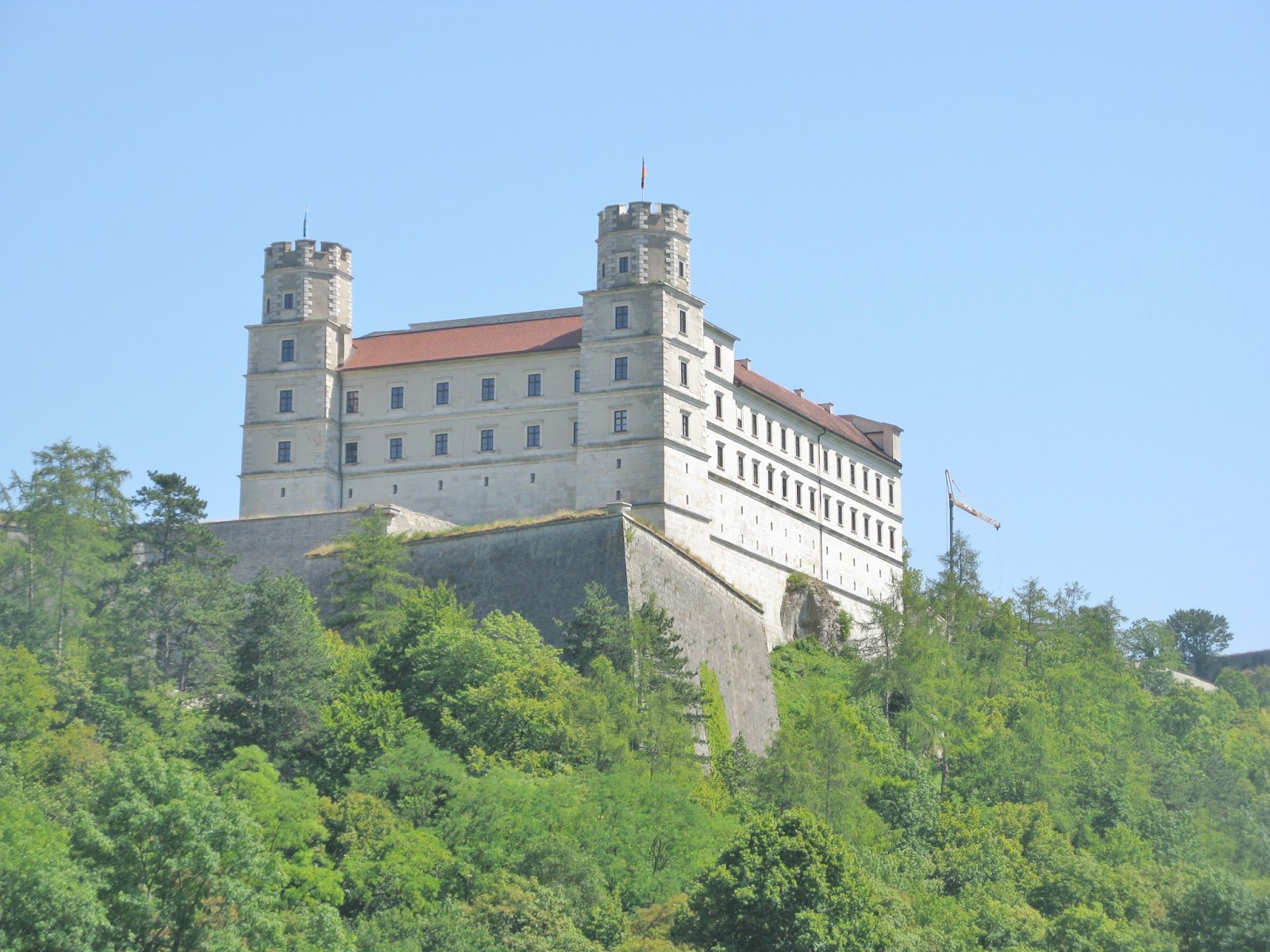
Coming into Eichstatt is the Willibaldsburg.  Around 1355 the Prince Bishop of Eichstatt wanted to have a fortified castle for protection.  In 1725 they built a residence in the town and moved out of the castle mostly.  Today it's a Jurassic museum.

This is the fountain in front of the Residence

And the guard station at the entrance to the Residence.

At the village of Pfunz there is another Roman ruins "Romerkastell Vetoniana".  Unfortuanately it was up a steep hill so we didn't go to it.  But there at the river crossing there was a roman bridge which we had to cross.

It was clouding up and threatening rain so we stopped in the village of Arnsburg.  The town has the usual castle ruins on the stone outcrop.  We called ahead to reserve a room at the schloss hotel not knowing that it would have been a hell of a climb to the place. Luckily they were on vacation.  We ended up at nice gestehaus in the village.  It did rain later that night.

8-5-2013 Muhr an See to Pappenheim

Leaving Muhr am See in the morning we ride along the lake for 6k to Gunzenhausen.   From below the dam at Gunzenhausen to Treuchtlingen the trail is in nature reserve which is on both sides of the Altmuhl.  At one time they had turned the river into a canal but that degraded the environment so they took out the canal and put the meander back in.  Tracts of land along the river are unfarmed and allowed to return to nature. 

This is the road sign for the village of Windsfeld.  It was voted the nicest village in Bavaria one year recently.

In Windsfeld the gestehaus has a large stork nest on the chimney.

Why does the stork cross the road?

This is the last of the stork stuff.  Actually in  the field there were 4 storks.  Johanna says they are now starting to get in flocks and head for North Africa for the winter.  They go by way of Gibraltor because it's shorter.

Near Trommetsheim we took an alternative route to the town of Weissenburg to see the roman Baths.   In Weissenburg there is a Roman fort "Remerkastell Biriciana" which was part of the "Limes Germanicus".  On the 8-20-2011 blog there were pics of another fort "Abusina" along the Danube.  Between 10AD and 300AD the Roman empire boundary was guarded by a series of forts numbering at least 6o with 900 guard towers between the Danube at Regansburg and the north Sea.  There was a continuous wooden palisade that stretched from the Danube to Rhine.  Later a rock wall were built.  This was built to keep out the Barbarian hordes like Johanna. 
The pic above shows the floor and the underlying channels where hot or cold water ran to heat or cool the separate rooms.

The cupolo was a cold room.  The ruins is in a building with walkways built over the ruins.  The were fire pits where the water was heated and allowed to circulate thru the channels.

After Weissenburg we came to a well pump.  Here Johanna is pumping water, half of which will flow to the Rhein and to the North Sea and half will flow to the Danube and to the black Sea.  In 793 Charlemagne ordered the construction of the "Fossa Carolina" to connect a tributary of the Regnitz to the Altmuhl, a tributary of the Danube.  This would have allowed boat traffic between the 2 drainages.  But things didn't pan out for the canal and it was used very little.  It wasn't until 1846 that  the "Ludwig"  canal  was built between Bamberg and Kelheim.  That was abandoned in 1950.  In 1992 Main-Donau Kanal was completed

After a hard days ride a beer goes good.  We got into the cute village of Pappenheim and got a room in a historic gestehaus.  It was built in the 1500s and used as a brewery for a long time then turned in a hotel. 

Monday, August 19, 2013

8-4-2013 Rothenburg to Muhr am See

Now we start the Altmuhl radweg which goes from Rothenburg to Kelheim on the Danube, about 250k.  It follows the Altmuhl river so is very mellow.   Since we've been on the Danube we will only go to Dietfurt and then ride the Main-Donau Kanal radweg back to Forchheim and then the train to Bad Kissingen.   The Burgenstrasse radweg goes from Mannheim to Prague thru Rothenburg.  We considered doing part of that ride until I got the book on it and saw it's very hilly.  It goes by some of the great castles of Germany and they seem to be built on hill.  We still may do a section before we leave.

It's not much but it's home.  This is Burg Colmberg by the village Colmberg.  When we rode thru town the was a detour around another fest that was happening.  It was too early to stop for a beer so we rode on.

When got to Leutershausen it was time for a beer.   There were 2 sidewalk cafes here across from one another.  The other one was packed with bike riders from the trail and there weren't any seats left.  But the we sat at served our purposes.

So here is our beer at a sidewalk cafĂ©.  Notice the flower on beer.  We had the beer then got on the bikes and rode about 100 meters and stopped at a bakery and got some plum cake.


This is Johanna wobbling out of Leutershausen after a beer.

We came upon this guy feeding in a field.  They seem not to mind people that much as he was only 150 feet away.

Now we are getting into an area where the church towers changed to this conical tower with the roofing tiles set in design.  It seem most of the churches after this for a way were in this format. 

Here's Johanna going thru the Storchenturm(stork tower) in Herrieden

Altmuhl river at Herrieden.  It's not much of a river.

After Herrieden it started raining so we set our sights on the village of Ornbau.  When we got there the 2 gestehauses were closed.  It looked like a nice village as it was partially walled.  But we had to press on and ended up in the village of Muhr Am See on the Altmuhlsee.  This pic is looking across the lake to the kloster at Gunzenhausen.  By the time we got here the sun had come out again and it was warm and muggy.   At the upper end of the lake is Vogelinsel reserve, about 300 acres for bird breeding.  After we got our room we rode out to the reserve and walked to the island via a bridge.  They have an elevated viewing area for birdwatchers and there were several.  The lake was formed in 1986 and is the upper end of the Franconian lake district. 

8-3-13 Weikersheim to Rothenburg

Back on the trail we came to Tauberrettersheim and the Steinbrucke bridge.  This bridge was built in 1733 by Balthasar Neumann, the architect of the Wurzburg Residence.  The bridge is still in use by traffic today.

Then we came to The Herrgottskirche outside of Creglingen.  We wanted to stop here because of the Riemenschneider altar.  If you look back a Aug 7, 2011 blog you will see other carvings by him in Steinach and Munnerstadt.  Probably his most famous is the altar in Rothenburg.  He lived between 1460 and 1531.  A lot of pilgrims show up here around mid August because the sun shines thru a window onto  the face of the Virgin Mary and they think it's a miracle.

This the church St Peter and Paul in Detwang  am Tauber below Rothenburg.  It to has a Riemenschneider.  These churches are getting smart and charging admission to see the artwork. 

The Altar by Riemenschneider in Detwang

This is the Toppler-schlossen, a medieval castle like structure along the Tauber, built by the mayor of Rothenburg , Heinrich Toppler in 1388.  The garden around it could be flooded if needed for protection.  It can now be rented as a holiday cabin.

We got a room outside the wall of Rothenburg(because it's a lot cheaper),  then walked thru the town to the Burggarten overlooking the Tauber Valley.  The picture is the burgtor entrance to the city.  Rothenburg is a completely walled city that's hardly changed in the last 300 yrs.  The main plaza was mostly under renovation and the Rathaus was covered.  The city is also famous for it's Torture Museum.  This is good city to view on Google earth and some of the pics from that site that I can't reproduce. 

When we were walking thru Rothenburg we looked up and there were 2 storks on the roof.  It could be that what the one is standing on used to be a nest that had blown off.  Stormy springs are hard on the chicks because they are in the open. 

Johanna really likes storks and we saw quite a few this trip and got pretty close so some of them. 

Tuesday, August 13, 2013

Aug 2 Weikersheim sculpture garden

Weikersheim has a sculpture garden with these statutes that we liked.  The first we saw were in the Kloster Bronnbach and are made by a guy from Wurzburg and were selling at the Kloster for 2300 euros each.  The city of Weikersheim had 22 of them set around the town in various places. 


The garden also had some great veggies